

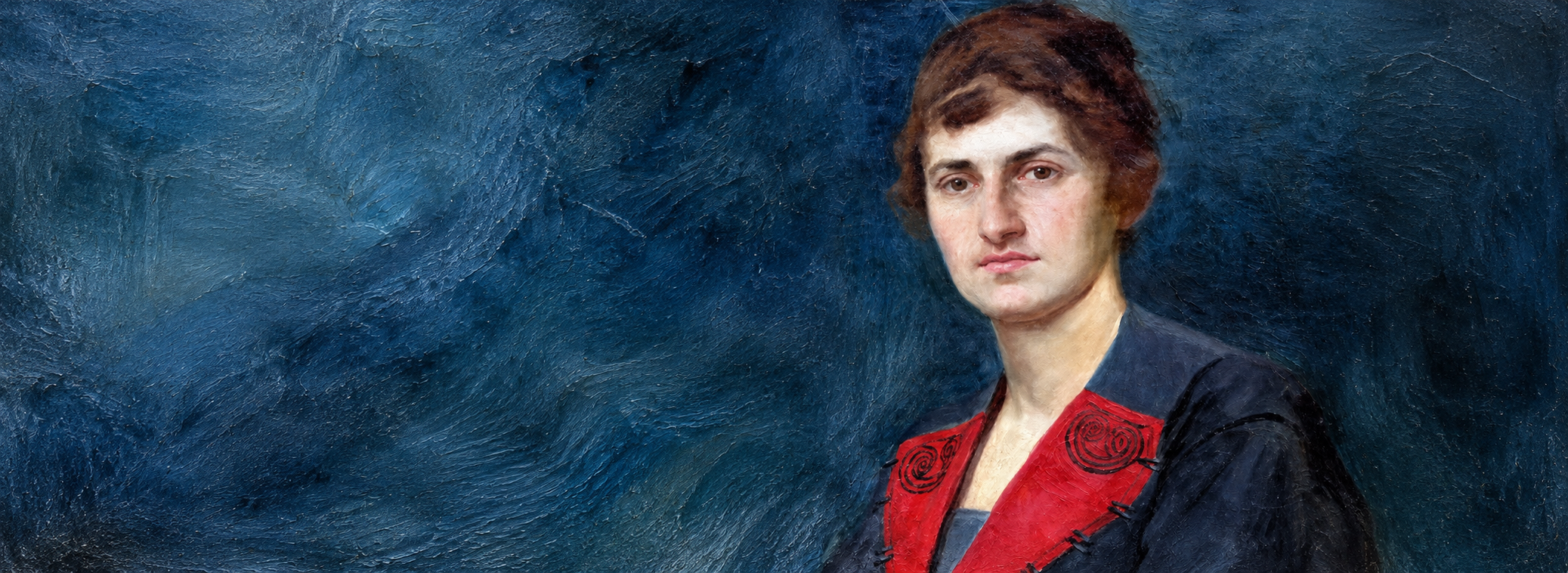
Academician Uroš Predić: A 1920 portrait enters the Foster + Svensson Private Art Collection
Novi Sad, Serbia – Foster + Svensson has acquired an artwork by Academician Uroš Predić, Portrait of Smilja Radosavljević Janković, painted in 1920, for its Private Art Collection.
Executed in oil on canvas mounted on board, the portrait enters the collection with an unusually rich historical record. Its significance lies not only in the identity of its author and the quality of the work, but also in the surviving documentation that connects the painting to Predić’s artistic legacy, to the name of its sitter, and to the historical geography of Banat. Most importantly, the work can be traced to a contemporary historical record of Predić’s oeuvre compiled by Mihovil Tomandl and published in 1963.
The acquisition therefore represents more than the addition of a significant work by one of Serbia’s most important painters. It brings into the Foster + Svensson Private Art Collection a work whose history can be studied through a combination of the painting itself, expert documentation, provenance records and a published bibliographic source.
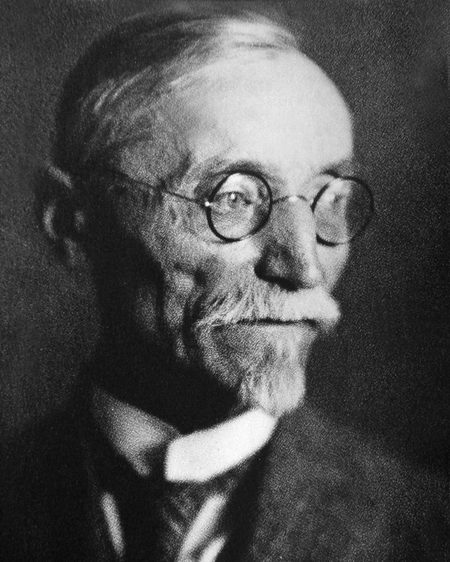
PHOTO: Academician Uroš Predić (1857 – 1953).
Academician Uroš Predić
Born in Orlovat in 1857, Uroš Predić received his early education in Pančevo before continuing his studies at the Academy of Fine Arts in Vienna. He entered the Academy in 1876 and graduated in 1880, studying under the distinguished Austrian painter and professor Christian Griepenkerl. Predić subsequently worked in Griepenkerl’s private studio and became closely involved with the academic artistic environment of Vienna, including work as an assistant at the Academy.
His Viennese education placed him within the Central European academic tradition of the late nineteenth century, while his subsequent career became deeply connected with Serbian cultural and artistic life. Predić became one of the defining representatives of academic realism in Serbian painting and one of its most accomplished portraitists. His biography, education, institutional career and academic distinctions are documented by the Serbian Academy of Sciences and Arts (SANU).
His career also reflects the cultural exchange between Serbia and the wider Central European artistic world. In 1889, Predić exhibited at the Exposition Universelle in Paris, presenting Herzegovinian Refugees and Orphan at Mother’s Grave. He received a bronze medal at the exhibition, while the Serbian-American scientist and philanthropist Mihajlo Pupin encountered the two works there and acquired them, subsequently donating them to a museum in Belgrade. This episode is documented in research published by the Museum of Vojvodina.
Predić’s artistic legacy encompasses portraiture, religious painting, historical compositions, genre scenes, drawings and monumental works. Among the best-known works associated with his name are Merry Brothers, Orphan at Mother’s Grave, Herzegovinian Refugees, Kosovo Maiden and Saint Sava Blesses the Serb Youth. His importance within Serbian academic realism and the continuing presentation of his work are reflected in the SANU exhibition Uroš Predić – The Noble Essence of Everyday Life.
Predić and the art of portraiture
Portraiture occupied a particularly important place within Predić’s oeuvre. His portraits are distinguished by the discipline of academic drawing, close observation and careful attention to the structure of the face, posture, clothing, materials and individual presence of the sitter. For Predić, portraiture extended beyond the representation of appearance. His portraits document individuals and, through them, the social and cultural world in which they lived. He portrayed prominent figures of Serbian public and cultural life as well as members of families and communities with whom he was personally connected.
Portrait of Smilja Radosavljević Janković belongs to this important aspect of his work. Painted in 1920, it dates from the mature period of an artist whose career had already extended across several decades and whose artistic language had been formed through both Viennese academic training and a sustained engagement with Serbian society and culture.
The painting is also particularly significant because its historical identity is supported by documentation extending beyond the object itself.
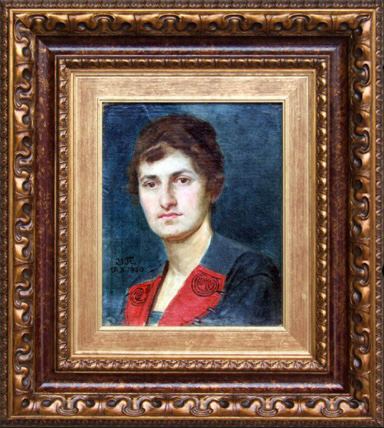
PHOTO: “Portrait of Smilja Radosavljević Janković”, oil on canvas mounted on board, from 1920. © Academician Uroš Predić; Foster + Svensson Private Art Collection.
A portrait with a documented historical record
The painting bears the signature “U.P. 19.X.1920”, providing a direct physical indication of the year in which it was executed. Its authenticity has been independently confirmed in expert documentation by art historians and museum advisors Nikola Kusovac and Mile Ignjatović, whose assessments identify the work as an original painting by Academician Uroš Predić, dated 1920, and identify the sitter as Smilja Radosavljević Janković.
The provenance documentation accompanying the work traces it to the artistic estate of Uroš Predić, preserved by his heirs in Pančevo, and records its subsequent history as a privately preserved work. The documentation also connects the painting with Tomaševac, a place that appears in the historical record of Predić’s work and family connections. Most significantly, the portrait has a direct reference in Mihovil Tomandl’s systematic bibliography and list of Predić’s works. Tomandl was a historian, bibliographer and close friend of Uroš Predić. Predić himself had maintained an extensive inventory of his works, and Tomandl subsequently used this material, together with his knowledge of the artist and his oeuvre, in preparing a systematic record.
Published by Matica Srpska in 1963, Tomandl’s Bibliografija i spisak radova Uroša Predića includes the work under entry 1252, in the section devoted to works from 1920. The entry reads: “Смиља М. Радосављевић, поклон, Томашевац.” In English, this may be rendered as: “Smilja M. Radosavljević, gift, Tomaševac.” The entry is found on page 163 of the published bibliography.
The complete digitised issue of the Matica Srpska Proceedings for Social Sciences provides direct access to the publication in which Tomandl’s bibliography appeared. The bibliographic record identifies the work as published in 1963 in volume 35, on pages 143–171. This short historical record is unusually valuable. Within a single line, it preserves the sitter’s name, the year of the work, its status as a gift, and its connection with Tomaševac. It provides an independent historical point of reference for a painting that has survived for more than a century.
For the history of the present work, the Tomandl entry is particularly important because it predates the painting’s present ownership by many decades. It places the work within a published record of Predić’s oeuvre and preserves a documentary connection between the portrait, the name Radosavljević and Tomaševac.

Predić, Tomaševac and the Radosavljević name
Tomaševac occupies a meaningful place in the broader biography of Uroš Predić. Historical material published by the National Museum of Serbia records Predić’s connections with relatives in Tomaševac and his stays there, during which he observed and sketched everyday life in Banat.
The village also appears in documentation relating to Predić’s wider family circle and artistic activity. Predić portrayed members of several Pančevo families, including members of the Radosavljević family; the National Museum of Pančevo preserves documentation concerning Predić’s portraiture and his connections with families of Pančevo, including the Radosavljević family.
These connections provide historical context for the present portrait without requiring assumptions about the precise genealogy of Smilja Radosavljević Janković. The documentary record is strongest where it is most specific: the name recorded by Tomandl, the place Tomaševac, the year 1920, the designation of the work as a gift, the physical signature and the later provenance and expert documentation.
For a work intended to remain available to future research, preserving that distinction between documented evidence and interpretation is itself part of responsible collecting.
A legacy held across museums and private collections
Predić’s legacy today is distributed across major Serbian cultural institutions, museum collections and private holdings. The scale and continuing relevance of his oeuvre have been demonstrated by major exhibitions bringing together works from the Gallery of Matica Srpska, the Serbian Academy of Sciences and Arts, the National Museum of Serbia, the National Museum of Zrenjanin, the National Museum of Pančevo, the Museum of the Serbian Orthodox Church, the Belgrade City Museum and other institutions.
Importantly, such exhibitions have also included works from private collections, many of which had not previously been exhibited to a wider audience. This aspect of Predić’s reception is significant for understanding the role of responsible private collecting in preserving cultural heritage: works that remain outside institutional collections may nevertheless retain substantial historical and scholarly value and can, when properly documented and preserved, contribute to the broader understanding of an artist’s oeuvre.
Predić’s own legacy is similarly preserved through more than paintings alone. Material associated with his life and work includes drawings, studies, photographs, letters, diaries, personal objects, catalogues and other documentation. A substantial part of the contents of his Belgrade studio was transferred to the National Museum of Zrenjanin in 1954, providing an unusually rich documentary foundation for the study of his artistic and personal world. This aspect of his legacy is discussed by SANU in its presentation of Predić’s studio and surviving material.
Recent exhibitions and scholarly initiatives have continued to bring previously little-seen or privately preserved Predić works into public and academic attention. The Gallery of Matica Srpska’s presentation of Uroš Predić u Sentandreji is one contemporary example of a Predić work preserved for decades within a private family heritage before being brought into wider public and scholarly attention. This continuing process of identification, preservation and interpretation demonstrates that the history of Predić’s oeuvre is not closed: works preserved in private hands can still contribute to the reconstruction of an artist’s career and the cultural environment in which he worked.
Contemporary recognition of Predić’s work
Predić’s historical importance is accompanied by continuing contemporary recognition. On 28 April 2025, a portrait by Uroš Predić, A Girl (Angelina, the Artist’s Niece at the Age of 7) with a Book in a Red Armchair, was sold at Dorotheum Vienna for €169,500, setting a new auction record for a work by the artist. The realised price was eleven times the presale estimate, and the painting was subsequently secured by the National Museum of Serbia.
The significance of this event extends beyond the financial result. It demonstrates continuing international interest in Predić’s work and the active reintroduction of important works from private and international markets into public cultural collections.
The story of Portrait of Smilja Radosavljević Janković belongs to this broader contemporary process of rediscovery and preservation. Its destination, however, is not the marketplace. It is the Foster + Svensson Private Art Collection, where the work joins a long-term cultural initiative centred on the preservation of significant works of art and the histories surrounding them.

Preserving a work of Serbian artistic heritage
The acquisition of Portrait of Smilja Radosavljević Janković reflects a principle at the heart of the Foster + Svensson Private Art Collection, a work of art is not defined solely by its physical presence, but also by the knowledge, documentation, memory and cultural context that accompany it. A painting such as this carries several histories at once. There is the history of its creation by Academician Uroš Predić; the history of its sitter; the history of the families and places connected with it; the history of its preservation; and the history of the people and institutions through whose records it can still be traced.
The Tomandl entry from 1963 is therefore more than a bibliographic reference. It is part of the painting’s documentary identity. The expert assessments of Nikola Kusovac and Mile Ignjatović, the physical signature dated 1920, the provenance documentation and the historical references to Tomaševac and the Radosavljević name together form a body of evidence that allows the work to be understood within the wider history of Predić’s art.
Foster + Svensson regards the preservation of such information as an integral part of collecting. By maintaining the work together with its historical and documentary record, the Private Art Collection seeks to ensure that the painting remains not only preserved, but also discoverable and researchable for future generations.
In this sense, the acquisition is both an act of collecting and an act of cultural stewardship.
More than a century after Predić placed his signature and date on the canvas, Portrait of Smilja Radosavljević Janković enters a new chapter of its history. Its preservation within the Foster + Svensson Private Art Collection ensures that the painting, together with the documentary trail surrounding it, remains available as part of the continuing story of Serbian art.
Artwork details
Artist: Academician Uroš Predić (1857–1953)
Title: Portrait of Smilja Radosavljević Janković
Serbian title: Rođaka Smilja
Date: 1920
Medium: Oil on canvas mounted on board
Artistic movement: Academic Realism
Signature: “U.P. 19.X.1920”
Collection: Foster + Svensson Private Art Collection
Artwork acqusition date: 10.10.2026
Research and reference record:
The principal historical reference for the present work is Mihovil Tomandl, Bibliografija i spisak radova Uroša Predića, Matica Srpska, 1963, entry no. 1252, p. 163, published in Zbornik Matice srpske za društvene nauke, vol. 35, pp. 143–171. The digitised publication is available through the Matica Srpska digital archive.
Additional institutional references include:
- Serbian Academy of Sciences and Arts — Academician Uroš Predić
- SANU — Uroš Predić – The Noble Essence of Everyday Life
- SANU — So, You Are Uroš Predić
- Museum of Vojvodina — material concerning Mihajlo Pupin and Uroš Predić
- National Museum of Serbia — Uroš Predić and Tomaševac
- National Museum of Pančevo — Uroš Predić and Pančevo
- Gallery of Matica Srpska — Uroš Predić
- Gallery of Matica Srpska — Uroš Predić u Sentandreji
- Dorotheum Vienna — Uroš Predić, A Girl (Angelina, the Artist’s Niece at the Age of 7) with a Book in a Red Armchair
- Foster + Svensson Private Art Collection
The work’s provenance and authenticity documentation are preserved with the painting in the Foster + Svensson Private Art Collection.
ABOUT FOSTER + SVENSSON
Foster + Svensson is an award-winning European branding, communications, and marketing company with heritage back in 1746 and incorporated in 2013 in Serbia, who put forward well-considered contemporary design, digital and innovation. Operating worldwide as part of Fosterova grupa, Foster + Svensson is positioned as professional services company, providing broad range of services and solutions in area of marketing and technology. Having bold experience and specialized skills in more than 20 industries, company provides services to all company sizes. People at Foster + Svensson design brands, use digital technology, data, and strategy to create contemporary visual identities, services, and experiences to help corporate clients improve their performance and manage sustainable business value for stakeholders. Foster + Svensson design and drive innovation to improve the way world works and lives. Company approach is to be precise, punctual, and reliable to its clients, where it ran more than 2000 projects while working for major companies to be found in Fortune Global 500 and top-tier companies, such as HVB Bank, UniCredit Bank, Raiffeisen Bank, Banca Intesa, Addiko Bank, AikBank, Visa, Mastercard, Ericsson, Nokia, Telenor Group, Apple, Vodafone Group, A1 Telekom Austria Group, T-Mobile, CNN, RTS, Ringier Axel Springer, Samsung, Cheil, McCann Worldgroup, MullenLowe Group, Grey Worldwide, Carat, Dentsu Aegis Network, WPP, Publicis Groupe, Leo, Saatchi & Saatchi, Huawei, HONOR, Hisense, Gorenje, Asko, Ahold Delhaize, Maxi, Nestlé, Procter & Gamble, AstraZeneca, Richter Gedeon, URSAPHARM, Takeda, Inditex, Zara, Zara Home, BMW Group, Renault Group, FIAT, Knight Frank. Work culture and ethics includes business excellence and delivery of outperforming results.
Foster + Svensson in one of the founders of MAI Marina Abramović Institute.